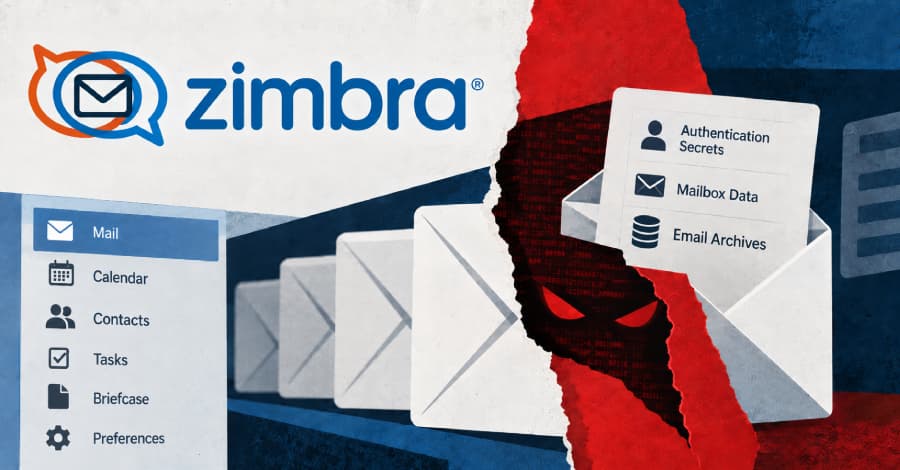
Attackers Exploit Zimbra Flaw to Deploy Web Shells and Harvest Authentication Secrets
Attackers are actively exploiting a Zimbra vulnerability to deploy web shells and steal credentials. Learn how to protect your enterprise email infrastructure.
Researched and edited by Kiran Ch and the WhatIsFuture editorial team. Reviewed for factual accuracy before publication.
When I first read Microsoft’s security research report on the recent wave of Zimbra exploits, my gut reaction was a mix of intense fascination and profound dread. As the founder of WhatIsFuture.com, I spend a massive chunk of my day analyzing technical shifts, cyber threat vectors, and the infrastructure powering critical digital services. Email remains the undisputed nervous system of enterprise communication, and when an attacker cuts into that nerve, the damage isn't just technical—it is deeply existential for the organization involved.
The campaign described in Microsoft’s security advisory isn't just another run-of-the-mill vulnerability story. It represents a targeted, highly methodical exploitation of Zimbra Collaboration Suite (ZCS) instances across government, telecommunications, and financial sectors worldwide. Threat actors, including tracked entities such as DEV-0796, leveraged unauthenticated remote code execution (RCE) flaws to drop malicious web shells directly into Zimbra’s directory structure. From there, they didn't just cause operational disruption; they systematically harvested authentication secrets, stolen credentials, and session tokens. In my view, this is one of the clearest demonstrations of why self-hosted edge infrastructure has become the primary battleground of modern cyber warfare.
Join Our Tech Community
Get instant alerts on the most critical AI breakthroughs on our WhatsApp channel. No spam, just signal.
The Anatomy of the Threat: Exploit Chains and Web Shell Droppers
To really appreciate why this attack wave is so dangerous, you have to look closely at how the exploit sequence unfolds. Attackers didn't rely on brute force or social engineering. Instead, they took advantage of known, unpatched vulnerabilities—most notably zero-day and n-day remote code execution flaws combined with authentication bypass bugs like CVE-2022-27925 and CVE-2022-37042. In my analysis of the attack chains, the real magic—and the real horror—happens during the initial payload delivery.
The adversaries targeted the file upload handlers inside Zimbra’s web server architecture. By sending specially crafted HTTP requests containing directory traversal sequences, they bypassed standard input validation filters. This allowed them to upload arbitrary JavaServer Pages (JSP) directly into public-facing web directories. Once uploaded, these JSP files acted as fully functional web shells.
I’ve spent years reviewing how compromise paths evolve, and JSP-based web shells in a Java enterprise application like Zimbra are particularly insidious. Because Zimbra runs a heavy stack relying on Jetty, Tomcat, and OpenLDAP, a web shell injected into the servlet context gains the privilege level of the executing web service user—often zimbra. From that moment, the security perimeter is essentially shattered.
"When a threat actor successfully plants a JSP web shell inside an enterprise email server, they aren't just peeking through a window; they have stolen the master key and rewritten the building's floor plan."
Why JSP Web Shells are an Attacker's Tool of Choice
In my opinion, the choice of JSP web shells highlights the deliberate minimalism of these threat groups. Instead of running noisy, external command-and-control (C2) agents that trigger Endpoint Detection and Response (EDR) alerts immediately, a JSP web shell blends natively into the HTTP traffic. To an unsuspecting network administrator or a basic web application firewall (WAF), the outbound and inbound connections look like standard HTTPS requests directed at legitimate webmail endpoints.
These web shells provided the attackers with a permanent, low-profile doorway. They could execute arbitrary shell commands, upload secondary malware stages, browse the internal file system, and interact directly with internal databases without creating a single traditional process creation alert on the underlying Linux host.
Secret Harvesting: Stripping the Fortress from the Inside Out
Once persistence was established via the web shells, the attackers shifted from initial access to their primary objective: secret harvesting. This is the stage of the attack that keeps me up at night, because the consequences extend far beyond a single server re-image.
Zimbra stores vast amounts of sensitive architectural metadata, configuration files, and authentication databases on the local server. The threat actors knew precisely where to dig. They focused their post-exploitation activities on several high-value target areas:
- Local Configuration XML Files: Attackers parsed configuration files like
localconfig.xmlto extract cleartext passwords, database credentials, and system-level encryption keys. - OpenLDAP Directories: Zimbra relies heavily on OpenLDAP for user authentication and user directory mapping. By querying the local LDAP store using built-in command-line tools like
zmprovor standard LDAP clients, attackers extracted full domain user rosters, password hashes, and administrative credential sets. - Zimbra Admin Tokens and Session Keys: By inspecting active memory or extracting session tokens, attackers were able to impersonate legitimate administrators, bypassing multi-factor authentication (MFA) mechanisms entirely for downstream applications that relied on single sign-on (SSO).
- Mailbox Content and PST Backups: The threat actors didn't just harvest technical credentials; they systematically dumped entire email archives, target search queries, and sensitive corporate files directly from the server.
In my view, credential harvesting at the mail server level represents the worst-case scenario for any Chief Information Security Officer (CISO). Once an adversary holds your core directory credentials and active session tokens, they no longer need to rely on exploits. They can simply log in as valid users, navigate your internal network, set up malicious email forwarding rules, and initiate lateral movement across your entire domain using legitimate corporate identities.
The Human and Organizational Element: Why Patch Friction Kills
One question I constantly ask myself at WhatIsFuture.com is this: Why do critical vulnerabilities in widely used platforms like Zimbra remain unpatched for months after fixes are released?
The answer isn't that system administrators are lazy or indifferent. The reality is far more complicated and speaks to the systemic issue of patch friction. Zimbra is heavily favored by enterprise organizations, public sector entities, educational institutions, and internet service providers (ISPs) precisely because it offers a cost-effective, self-hosted alternative to proprietary SaaS ecosystems like Microsoft 365 or Google Workspace. However, self-hosting comes with an immense maintenance debt.
Upgrading a mission-critical email server isn't like updating a web browser. It requires maintenance windows, complex backup procedures, database schema validations, and extensive testing to ensure custom integrations, routing rules, and SSL/TLS certificates don't break during the process. In large organizations, scheduling a multi-hour downtime window for the primary mail platform can take weeks of bureaucratic approval.
Adversaries know this operational lag exists. They monitor vendor patch releases, reverse-engineer security updates within hours, and launch automated scanning campaigns across global IP ranges to find unpatched servers before security teams can complete their change-management cycles. In this race, the attackers hold every structural advantage.
Architectural Lessons for the Future: How We Must Adapt
Looking at Microsoft’s findings, it is clear to me that relying solely on reactive patching is a failing strategy. If your defense model assumes that your public-facing applications will never have an unauthenticated RCE flaw, you are operating on borrowed time. We must adopt an architectural security posture that minimizes the impact when an exploit inevitably occurs.
Here are my key observations on how security teams should re-architect their Zimbra and edge application environments to mitigate these risks:
1. Enforce Aggressive Network Segmentation and Egress Rules
A web mail server needs to listen on ports 80/443 for web traffic and standard SMTP ports for mail handling. It rarely needs unrestricted outbound internet access to arbitrary IP addresses. By placing strict egress filtering rules on mail servers, you prevent deployed web shells from reaching out to adversary C2 infrastructure or downloading secondary execution scripts.
2. Implement Strict File Integrity Monitoring (FIM)
Web shells survive by hiding in plain sight within web root directories. Implementing File Integrity Monitoring on critical web paths—such as Zimbra's web application directories—allows real-time detection whenever a new .jsp, .php, or execution file is created or modified. If an unauthorized JSP file appears in a production path, an automated response should instantly quarantine the file and isolate the instance.
3. Isolate the Management and Administrative Interfaces
The administrative portal for Zimbra (typically running on port 7071) should never be exposed directly to the public internet. It must be locked behind strict network access control lists (ACLs), explicit jump-host architectures, or enterprise VPN/Zero Trust Network Access (ZTNA) solutions. Restricting access to management APIs drastically reduces the surface area available to unauthenticated attackers.
4. Shift Toward Read-Only File Systems for Web Apps
Where possible, application runtime environments should run with read-only root and web-root filesystems. If the web server process (such as Jetty or Tomcat) lacks write permissions to its own web directory during standard operations, an attacker exploiting a directory traversal bug will fail to write the web shell payload to disk.
My Final Take on the Zimbra Exploitation Wave
The wave of attacks on Zimbra servers documented by Microsoft serves as a stark reminder of the realities of modern enterprise cybersecurity. As threat actors mature, their techniques are becoming increasingly refined: fast exploit weaponization, living-off-the-land persistence, and stealthy secret harvesting. Email servers remain the central crown jewels of corporate infrastructure, containing not just historical intelligence, but the operational keys to the entire enterprise kingdom.
At WhatIsFuture.com, I will continue to track these technical shifts closely. The key takeaway for every technologist and security practitioner is simple: we cannot prevent every bug from existing, but we can build defensive systems resilient enough that a single web shell doesn't lead to a total organizational breach.
Frequently Asked Questions
Why are threat actors actively targeting Zimbra Collaboration Suite over cloud-native platforms like Microsoft 365?
Self-hosted platforms like Zimbra are hosted directly on enterprise network perimeters, giving organizations full operational control. However, this also means the organization is entirely responsible for patch management, perimeter defense, and system hardening. Threat actors target Zimbra because unpatched instances offer direct, full-privilege underlying operating system access, whereas cloud platforms like Microsoft 365 isolate workloads within heavily monitored, multi-tenant environments where executing server-side web shells is substantially more difficult.
How can system administrators detect if hidden web shells exist in their Zimbra installation?
Administrators should conduct regular file integrity checks against known-good baseline installation images. Specifically, inspect directories such as /opt/zimbra/jetty/webapps/ and /opt/zimbra/mailboxd/webapps/ for unexpected .jsp or .jspx files. Additionally, reviewing HTTP access logs for unusual POST requests directed to static asset folders or unfamiliar JSP endpoints can help uncover active web shell interactions.
What immediate steps should be taken if a Zimbra server is suspected
This analysis was inspired by a story originally reported by The Hacker News. Read the original report →
Supercharge Your Workflow with Claude AI
The AI assistant used by professionals worldwide. Write, code, analyse — all in one place.