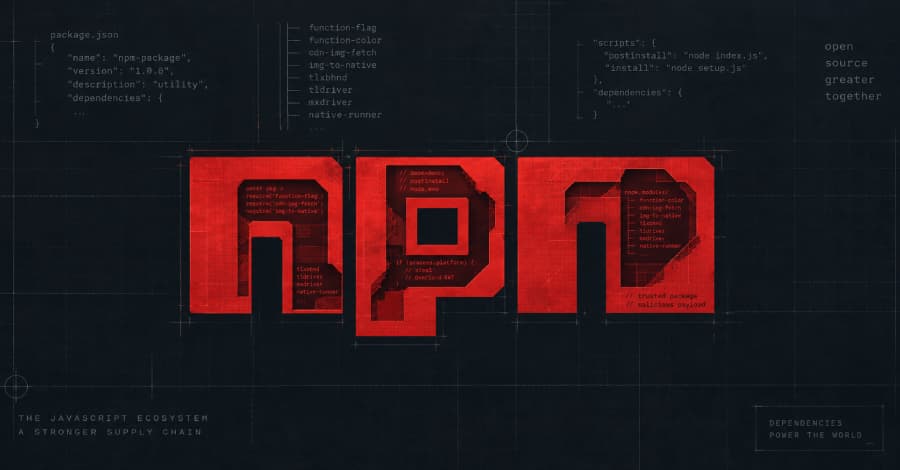
Eight Malicious npm Packages Downloaded 40,767 Times Deliver Overlord RAT and Stealer
Cybersecurity researchers have disclosed details of a long-running npm supply chain malware campaign that pushes information stealers and remote access trojans (RAT) to compromised hosts. The campaign...
Researched and edited by Kiran Ch and the WhatIsFuture editorial team. Reviewed for factual accuracy before publication.
When I first read about eight rogue npm packages secretly accumulating over 40,000 downloads before getting taken down, my gut reaction was pure frustration—and honestly, a total lack of surprise. At WhatIsFuture.com, I've been following supply chain attacks for a while now, watching them transform from obscure academic proof-of-concepts into well-oiled corporate espionage operations. Developers globally hit npm install dozens of times a day, treating open-source registries like a pristine public tap water system. But let me be direct about this: open-source registries are not safe utilities. They are chaotic digital open-air markets where anyone can slip a poisoned drop into the bucket, and we are paying the price for our collective laziness.
This latest campaign wasn't just some script kiddie flexing basic coding chops. Threat actors managed to push packages containing both information stealers and the Overlord Remote Access Trojan (RAT), silently infiltrating systems across thousands of environments. What makes my skin crawl is how easily these malicious routines slip past modern development pipelines. We have spent billions building zero-trust perimeter defenses, firewalling corporate networks, and requiring multi-factor authentication everywhere, only to leave the side door wide open for any package manager to pull unvetted binaries straight onto developer laptops.
Join Our Tech Community
Get instant alerts on the most critical AI breakthroughs on our WhatsApp channel. No spam, just signal.
Key Takeaways
- Postinstall scripts remain a gaping security hole: Malicious npm packages continuously exploit unvetted execution scripts to drop payloads before security scanners even analyze the core package code.
- Download counts are dangerously misleading: Over 40,000 downloads occurred not because 40,000 human developers were fooled, but because automated CI/CD builds and transitive dependencies multiply installation metrics exponentially.
- Dual-payload strategy represents a lethal evolution: Threat actors are combining immediate credential theft with persistent Overlord RAT access to monetize developer machines instantly while maintaining long-term backdoors into production infrastructure.
- Current scanning tools are failing software teams: Traditional static analysis tools miss obfuscated payloads and dynamic drops; organizations must adopt runtime behavioral monitoring for open-source package installations.
The Mechanical Anatomy of the Overlord npm Campaign
Let's look at how this campaign actually worked under the hood. Cybersecurity researchers recently disclosed that eight distinct packages sitting on the official npm registry were quietly dropping two separate strains of malware: an information stealer and the Overlord Remote Access Trojan. The packages operated by masking themselves as harmless utility libraries. Some leveraged subtle typosquatting tricks, mimicking legitimate JavaScript libraries that developers copy-paste into their package.json files without double-checking every single letter. Others were presented as brand-new helper modules promising quick fixes for common frontend tasks.
Here's what gets me about the mechanics: the attackers didn't put the primary payload directly into the main index file where static analysis scanners usually look. Instead, they weaponized the package lifecycle hooks, specifically the postinstall script. The moment a developer or an automated build agent typed npm install, the registry engine automatically executed the postinstall script with full user permissions. That script reached out to a remote command-and-control server, downloaded an encrypted binary, decoded it in memory, and executed the RAT without ever writing an unencrypted file to disk during the initial fetch phase.
It is a ridiculously simple trick, yet it works repeatedly. We see similar stealth techniques across the cyber threat landscape, whether it is threat actors using Fake ChatGPT, Gemini, and Claude Ad Portals Capture Credentials and MFA Codes or hackers setting up deceptive web infrastructure like 100+ Compromised Websites Use Fake Cloudflare Checks to Deliver LunexStealer. The goal is always the same: exploit user implicit trust before security filters realize what happened. In the case of this npm campaign, by the time the community raised flags, those eight packages had already been pulled into 40,767 environments.
We need to stop assuming that high download numbers equal code safety. In the JavaScript ecosystem, automated build runners, Docker image builds, and automated testing suites pull dependencies automatically dozens of times a day. If a malicious library becomes a transitive dependency of even one moderately popular package, thousands of builds will fetch it automatically. Those 40,000+ downloads aren't 40,000 careless engineers—they are automated systems executing instructions blindly, exactly as they were programmed to do.
Why Open Source Ecosystems Are an Attacker's Paradise
I've lost count of how many times I've debated open-source security with engineering leads who argue that "community eyes" keep registries clean. That argument is completely broken. Modern software development relies on deep, complex trees of third-party modules. A single React or Node.js application might rely on thousands of sub-dependencies written by hundreds of individual maintainers across the globe. Nobody is auditing that entire code tree by hand. No one.
Registry operators like npm (owned by GitHub and Microsoft) face an asymmetric battle. They host millions of packages and handle billions of downloads every month. While they run automated security scanners to detect known signatures, attackers constantly alter their obfuscation routines, change domain names, and split malicious payloads across multiple benign-looking dependencies. When an attacker uploads a fresh package with zero prior reputation history, traditional threat intelligence feeds have zero data on it. It enters the registry as clean code.
And that's the real story here. The structural architecture of Node package management gives untrusted code incredible leverage over local system environments. When an engineer installs a package, that package gets the exact same system permissions as the developer running the command. If the developer has administrative access, read/write access to corporate repositories, stored SSH keys, and unencrypted environment variables sitting in a local
This analysis was inspired by a story originally reported by The Hacker News. Read the original report →
Supercharge Your Workflow with Claude AI
The AI assistant used by professionals worldwide. Write, code, analyse — all in one place.