Injective Labs GitHub Compromise Pushes Wallet-Key-Stealing npm Packages
Unknown threat actors compromised the Injective Labs SDK project's GitHub repository and leveraged it to publish a malicious package on the npm registry to steal cryptocurrency wallet private keys and...
WhatIsFuture AI Editor
Contributor
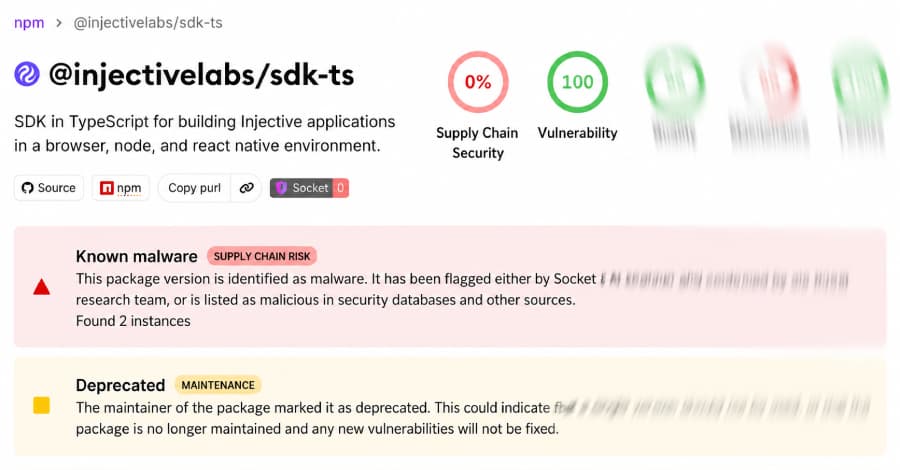
Decentralized finance (DeFi) is racing toward a multi-trillion-dollar future, but its underlying infrastructure remains perilously vulnerable. In a stark reminder of this reality, unknown threat actors recently breached the GitHub repository of Injective Labs—a prominent Layer-1 blockchain ecosystem—using it as a launchpad to distribute malicious npm packages designed to siphon cryptocurrency wallet private keys.
This sophisticated attack highlights a shifting frontline in cyber warfare: hackers are no longer just targeting smart contracts; they are poisoning the very tools developers use to build them.
---
The Anatomy of the Injective Labs Exploitation
The breach, originally reported by *The Hacker News*, targets the software supply chain—a highly effective vector for modern cybercriminals. By gaining unauthorized access to the Injective Labs SDK (Software Development Kit) GitHub repository, attackers injected malicious code directly into the project's codebase.
This compromised code was subsequently published to the npm registry, the world’s largest software registry for JavaScript developers. Once integrated into developer environments or downstream applications, the poisoned package silently harvested sensitive cryptocurrency credentials, specifically targeting:
- Private keys of digital wallets.
- Mnemonic seed phrases used for wallet recovery.
- Sensitive API credentials and environment variables.
---
Why Web3 Supply Chains Are the New Goldmine
This incident highlights a growing, alarming trend in the tech industry. In the Web3 era, developers rely heavily on open-source packages and SDKs to build decentralized applications (dApps) rapidly.
If a threat actor can compromise a single widely used dependency—such as an SDK from an established player like Injective Labs—they can effortlessly compromise hundreds of downstream applications.
"We are witnessing a paradigm shift in cyberwarfare," notes the *WhatIsFuture.com* editorial team. "Attackers realize that securing a blockchain is useless if the developer tools used to build on top of it are compromised at the source."
The trust model of open-source development is being weaponized. When developers run a simple installation command, they implicitly trust thousands of lines of third-party code.
---
Securing the Future of Decentralized Infrastructure
For developers and organizations navigating the Web3 landscape, this breach serves as an urgent wake-up call. Relying blindly on open-source registries without rigorous, automated vetting is no longer viable.
To safeguard the future of DeFi, the developer community must adopt stricter security hygiene, including:
- Strict Access Control: Enforcing mandatory multi-factor authentication (MFA) and branch protection rules across all GitHub repositories.
- Dependency Pinning and Auditing: Locking down exact package versions and employing automated tools like Socket or Snyk to detect anomalous code changes in real-time.
- Behavioral Monitoring: Implementing run-time security tools that alert developers when a package attempts to make unauthorized external network connections.
Supercharge Your Workflow with Claude AI
The AI assistant used by 100K+ professionals. Write, code, analyse — all in one place.