FBI Says China-Linked Hackers Ran Portal Giving Third Parties Access to Stolen Emails
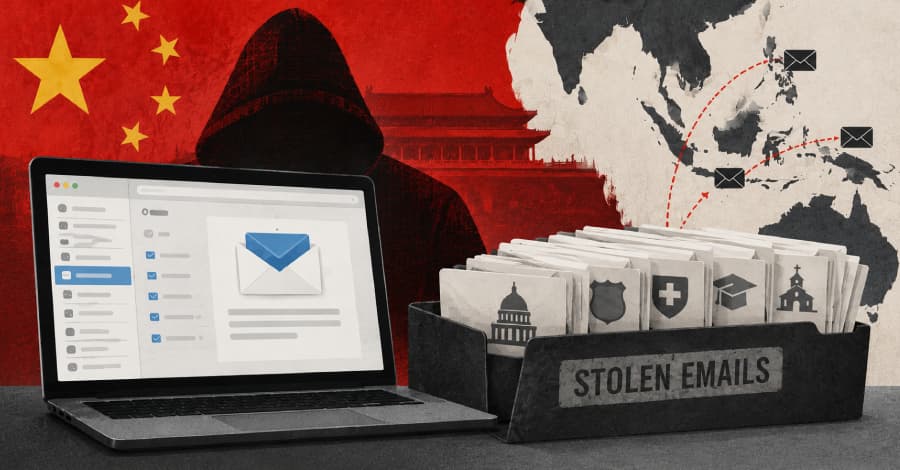
Hackers tied to a Chinese cybersecurity company stole email from government organizations, law enforcement agencies, healthcare systems, and religious institutions in Southeast Asia, the FBI and agenc...
Researched and edited by Kiran Ch and the WhatIsFuture editorial team. Reviewed for factual accuracy before publication.
Key Takeaways
- State-backed hacking has gone fully commercial: Chinese threat actors are monetizing and distributing exfiltrated intelligence through organized web portals, effectively creating a Software-as-a-Service model for stolen data.
- Soft targets are primary targets: Healthcare providers, local law enforcement, and religious organizations in Southeast Asia were aggressively targeted alongside official diplomatic bodies to aggregate comprehensive intelligence profiles.
- Credential security is broken: Perimeter defenses mean nothing when attackers bypass them entirely to siphon email archives directly into indexed databases.
- Defense requires real-time identity monitoring: Organizations must shift away from legacy perimeter security toward continuous data lineage tracking and zero-trust email access protocols.
The Commercialization of State-Sponsored Espionage
Let me be direct about this. For years, the security industry treated state-sponsored threat groups like isolated military divisions. You had APT groups targeting high-value defense contractors or foreign ministries, quietly exfiltrating files to feed internal intelligence reports. That clean narrative is completely dead. What the FBI, CISA, and international partner agencies exposed in this advisory is the industrialization of stolen intelligence.
A commercial cybersecurity company acting on behalf of foreign state interests did not just hack these targets—they productized the loot. They built an interactive search portal complete with indexed email bodies, metadata, contact lists, and attachment parsers. Think of it as a dark-web search engine specifically tuned for compromised email accounts across Southeast Asia. If an authorized third party wanted to look up what a specific ministry official said about a trade route or what a local law enforcement chief was investigating, they simply logged in and ran a search query.
Join Our Tech Community
Get instant alerts on the most critical AI breakthroughs on our WhatsApp channel. No spam, just signal.
This setup lowers the barrier to entry for intelligence consumers within the threat actor's ecosystem. Instead of forcing raw network captures or unorganized email archives down to human analysts, the operational group handled the ingestion, parsing, and database indexing on their end. It represents a massive operational shift. Cyber espionage is no longer just about harvesting data. It is about building scalable distribution platforms for stolen knowledge.
What makes this particularly dangerous is the economic model behind it. When you transform raw stolen data into a searchable portal, you multiply its value. Multiple clients or state offices can access the same exfiltrated dataset simultaneously without needing technical hacking capabilities of their own. The hacking collective handles the break-in, maintaining persistent access, while their end-users simply consume the intelligence through a browser window.
The Technical Mechanics Behind the Stolen Email Portal
Here's what gets me about the technical architecture. To build a reliable search portal for millions of stolen emails across dozens of distinct organizations, you need robust infrastructure. The threat actors were not just dropping files on a basic FTP server. They ran sophisticated backend operations to aggregate incoming data streams from compromise vectors like vulnerable edge routers, unpatched exchange servers, and targeted spear-phishing campaigns.
Once inside an target mail server, the attackers pulled down complete mailboxes using automated scripts. These exfiltrated mailboxes were fed into centralized databases equipped with full-text search engines. We are talking about modern indexing, keyword tagging, and cross-domain identity mapping. That allowed third-party users—likely other state-linked entities, proxy intelligence brokers, or commercial clients—to search across multiple victim organizations simultaneously.
We saw a similar breach of digital trust when looking at how rogue actors exploit systems in the commercial world, such as when the MonsterCloud owner was accused of billing millions while secretly paying ransoms. The underlying thread in both cases is the deceptive repackaging of compromised infrastructure for financial and strategic leverage. When bad actors control the underlying data pipeline, they dictate who gets access to the truth and at what cost.
Maintaining persistence across these email systems required constant evasion. The threat actors used living-off-the-land techniques, stolen session cookies, and compromised local VPN credentials to keep the data flowing into their search portal without triggering standard firewall alerts. The victim organizations had no idea their internal communications were being mirrored, indexed, and served to outside users through a clean web dashboard.
Why Southeast Asia Was Hit so Aggressively
In my view, Southeast Asia has become the primary global battleground for cyber reconnaissance, and this campaign proves it. The targeted institutions spanned government ministries, maritime enforcement agencies, regional healthcare networks, and even religious institutions. Why hit such a broad, seemingly disconnected collection of entities? Because in modern espionage, context is everything.
Hacking a foreign ministry gives you diplomatic policy memos. Hacking a regional healthcare system gives you health profiles, travel records, and personal vulnerabilities of public figures. Hacking religious organizations provides crucial visibility into socio-political movements and grassroots opposition networks across regional borders. By combining all these vectors into a single searchable web portal, the attackers created an all-encompassing intelligence engine over Southeast Asian affairs.
Smaller nations and non-governmental entities in the region often operate with severely underfunded cybersecurity budgets. They lack the dedicated threat-hunting teams required to detect stealthy persistence on their internal mail servers. The threat group recognized this structural weakness and exploited it at scale, turning regional infrastructure into a permanent intelligence-gathering field.
This dynamic creates a severe power asymmetry. When a nation's law enforcement and healthcare communications are sitting inside a searchable database hosted by a foreign cyber company, strategic autonomy disappears. Regional leaders are effectively
This analysis was inspired by a story originally reported by The Hacker News. Read the original report →
Supercharge Your Workflow with Claude AI
The AI assistant used by professionals worldwide. Write, code, analyse — all in one place.