Japan Sees Sharp Rise in Web Data Leaks Amid Mobile API Abuse and Metabase Attacks
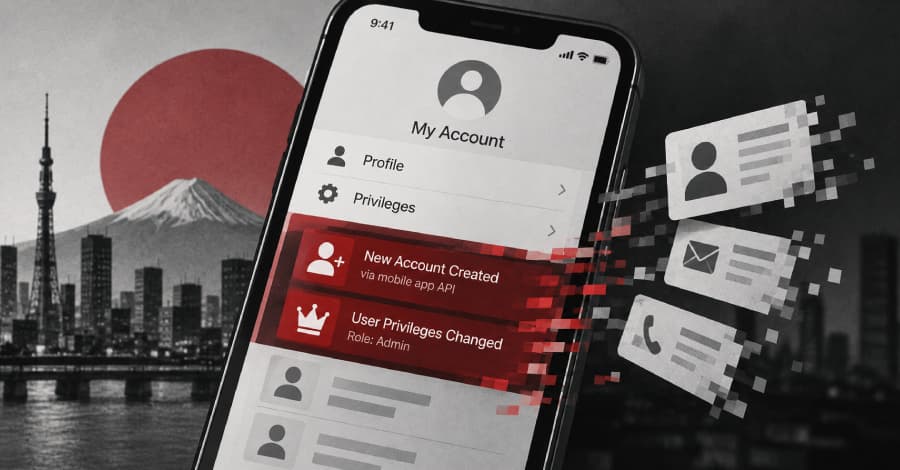
Attackers behind a string of personal data leaks at Japanese organizations have abused APIs for mobile apps and targeted known software flaws, the JPCERT Coordination Center (JPCERT/CC) said. The Toky...
Researched and edited by Kiran Ch and the WhatIsFuture editorial team. Reviewed for factual accuracy before publication.
Key Takeaways
- Mobile APIs are exposed targets: Attackers regularly reverse-engineer Android and iOS apps to extract hidden API endpoints, hardcoded tokens, and weak backend queries.
- Unpatched internal tools create catastrophic leaks: Exposed instances of open-source software like Metabase are being scanned and exploited via known remote code execution (RCE) flaws.
- Authentication without authorization fails: Validating a user login means nothing if your API endpoints allow callers to access other users' data records without checking ownership rules.
- Structural remediation is required: Japanese organizations must move away from perimeter-only defenses and implement zero-trust API gateways alongside automated patch workflows.
The Hidden Danger of Mobile API Endpoint Assumptions
Here's what gets me about modern application development: developers spend months hardening web frontends, configuring web application firewalls, and setting up multi-factor authentication for browser users, only to leave backend REST and GraphQL endpoints completely unprotected for mobile users. They build an iOS or Android client and assume that because the user interface doesn't show a direct database query or an administrative panel link, nobody will ever find the underlying HTTP requests. That mindset is completely broken.
Mobile apps don't hide secrets. Period. Anyone with a basic proxy tool like Burp Suite or Charles Proxy can route their smartphone traffic through an interceptor, monitor every JSON response, and uncover every undocumented API route your server exposes. In the recent incidents highlighted by JPCERT/CC, threat actors didn't execute complex cryptographic exploits. They simply decompiled mobile packages, captured the API endpoints used by mobile clients, and realized those APIs lacked fundamental access control checks.
Join Our Tech Community
Get instant alerts on the most critical AI breakthroughs on our WhatsApp channel. No spam, just signal.
This dynamic leads straight to Insecure Direct Object References (IDOR). An attacker logs into their own account on a mobile application, captures the API call fetching their profile (e.g., /api/v1/user?id=10422), and simply changes the parameter to iterate through sequential numbers. Because the backend developer assumed only legitimate app logic would call that endpoint, the API happily spits out the personal data of millions of registered users. It is automated, silent, and virtually indistinguishable from regular app traffic if you aren't actively monitoring for anomalous API call patterns.
Metabase Flaws and the Software Supply Chain Nightmare
While mobile API abuse represents a failure of business logic, the second major vector identified in Japan represents a failure of basic software lifecycle hygiene: unpatched open-source infrastructure. Specifically, attackers have aggressively targeted instances of Metabase, a popular open-source business intelligence and analytics dashboard. When companies connect Metabase directly to their primary production databases to generate internal metrics, they create a target of massive value.
The problem deepens when those Metabase instances are exposed directly to the public internet without proper IP whitelisting or SSO requirements. When critical vulnerabilities drop—such as the notorious pre-authentication remote code execution flaw tracked as CVE-2023-38646—threat actors launch automated global scanning sweeps within hours. If an enterprise takes weeks or months to apply a critical security patch, attackers execute code, gain initial access to the server, and extract credentials linked to core data stores.
"Treating mobile APIs as private internal routes is the tech debt equivalent of leaving your house key under the doormat and assuming burglars won't look there because the doormat is brown."
And that's the real story here. We often see corporate security posture collapse not at the edge firewall, but through third-party utility tools that developers spin up for quick data visualization. When operational teams lose track of shadow IT instances running on subdomains, those unpatched servers turn into quiet data exfiltration hubs. We saw similar systemic vulnerabilities and shady operational practices exposed in the case where the MonsterCloud owner was accused of billing over $19M while secretly paying ransoms to decrypt data, proving that failing to manage underlying infrastructure always comes back to haunt organizations financially and publicly.
Why Japanese Enterprises Are Caught Off Guard
To understand why Japan is experiencing this specific surge right now, you have to look at how enterprise IT is historically structured across the country. For decades, Japanese corporations have relied heavily on traditional System Integrators (SIers) and multi-tiered IT outsourcing. Under this model, an enterprise hires a primary vendor to build an application, and that vendor subcontracts different components—such as the mobile client or the database architecture—to smaller software shops. This structural model worked well in the desktop era, but it struggles in a modern, API-driven threat environment.
When software development is fragmented across multiple third-party contractors, security accountability gets lost in the handoffs. The team building the mobile app assumes the backend team has implemented robust rate limiting and object-level permissions. The backend team assumes the mobile client will sanitise all input and act as the sole interface for users. Neither side tests what happens when an adversary bypasses the mobile app entirely and talks directly to the server. Furthermore, once the project is delivered, ongoing patch management for tools like Metabase often falls into a organizational void where no party is contractually obligated to perform emergency out-of-band updates.
Meanwhile, global threat actors do not care about localized vendor contracts or administrative boundaries. Automated threat bots continuously probe global IPv4 ranges, treating Japanese IP blocks with the same aggressive scanning techniques used everywhere else. While big tech pushes hardware-level capabilities — as seen when Microsoft releases new Nvidia-chip AI PCs with revamped Windows 11 to harden endpoint architecture — many regional enterprises are still struggling with basic cloud backend posture. The mismatch between sophisticated local user interfaces and outdated, unpatched backend controls makes these systems low-hanging fruit for threat groups.
Rebuilding API Security and Infrastructure Sanity
Let me be direct about this: if you don't inventory your APIs today, an attacker will do it for you tonight. The string of data breaches reported by JPCERT/CC must serve as an urgent wake-up call for engineering teams across Asia and beyond. Securing these environments doesn't require reinventing computer science, but it does require abandoning lazy architectural assumptions.
First, organizations must deploy dedicated API Security Posture Management (APSPM) solutions. Standard Web Application Firewalls (WAFs) are simply not tuned to catch IDOR vulnerabilities or logic flaws in JSON payloads. You need security controls that examine the authorization layer of every incoming request, ensuring that user token A is explicitly permitted to access data object B before the backend application returns a payload. Rate limiting must also be applied at both the endpoint and individual user token levels to prevent automated mass data scraping.
Second, open-source business intelligence tools like Metabase, Superset, or Grafana should never exist on open, public-facing subdomains without zero-trust network access (ZTNA) or VPN enforcement. If an administrative query engine must be accessed remotely, place it behind an identity-aware proxy that requires strict multi-factor authentication before a single packet even reaches the application layer. Coupled with an aggressive, automated vulnerability management routine that flags known CVEs instantly, companies can seal the precise gaps that threat actors are exploiting across Japan today.
Frequently Asked Questions
Why are APIs for mobile apps frequently targeted in data leak attacks?
Mobile APIs are prime targets because developers often assume that users will only interact with backend endpoints through the official app interface. Attackers easily inspect or reverse-engineer mobile applications to discover unprotected endpoints, bypassing the app UI completely to query databases directly through unauthorized or unmonitored scripts.
How does an unpatched Metabase instance lead to an enterprise data leak?
Metabase is often connected directly to core databases to generate business reporting. When left exposed on the open internet with unpatched remote code execution (RCE) flaws, attackers can run arbitrary commands on the host server, extract stored database credentials, and dump customer data without needing valid application login credentials.
What immediate steps should organizations take to mitigate API abuse?
Organizations should immediately conduct a full API discovery audit to map all exposed endpoints, enforce strict object-level access control (validating that the authenticated user owns the requested record), implement strict rate-limiting policies, and move all internal analytics tools behind a zero-trust network interface.
This analysis was inspired by a story originally reported by The Hacker News. Read the original report →
Supercharge Your Workflow with Claude AI
The AI assistant used by professionals worldwide. Write, code, analyse — all in one place.