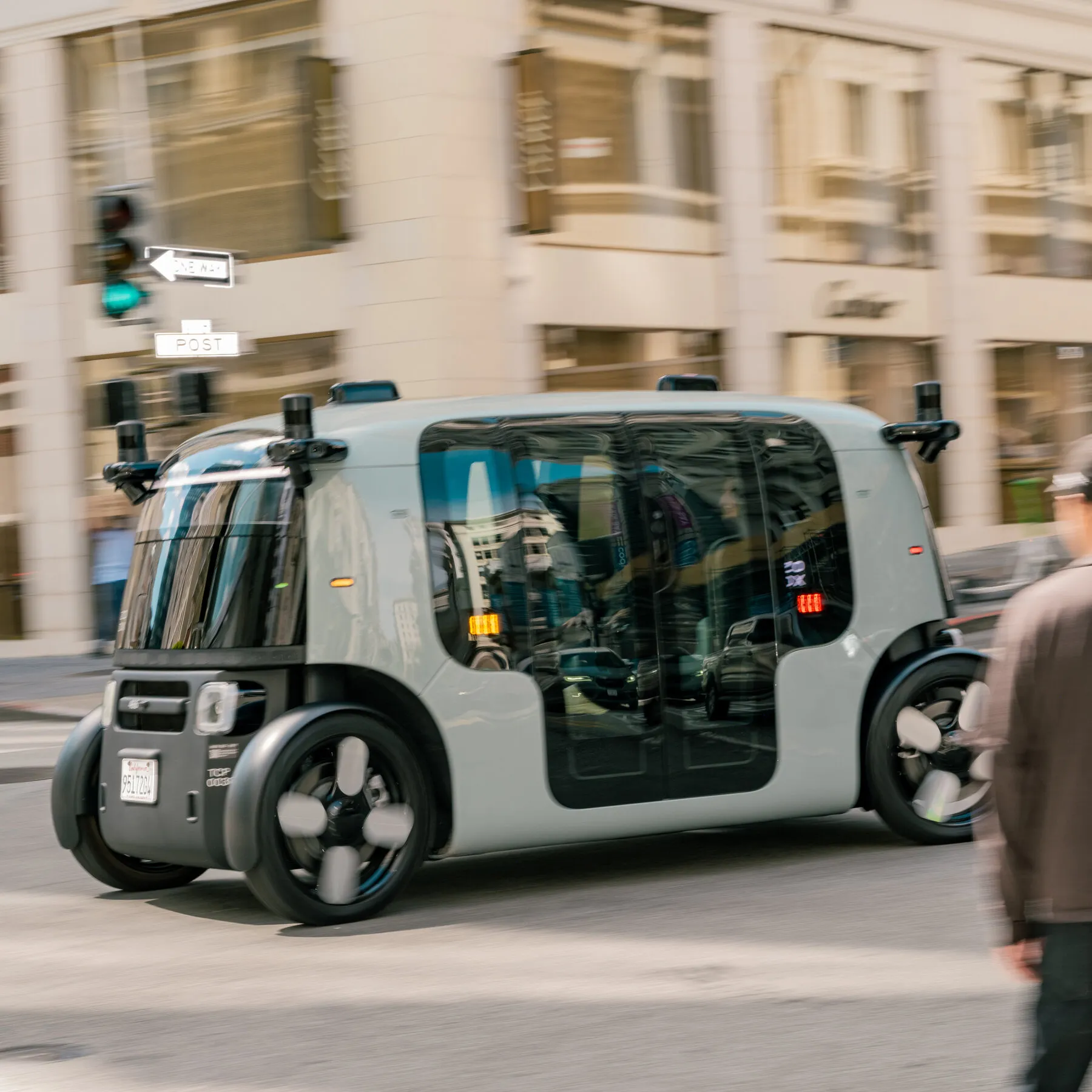
How Amazon’s Zoox Is Taking On Waymo in San Francisco
The Amazon-owned driverless car company is a distant second to Waymo. Its pitch to riders? Wine pop-ups, festival sponsorships and a car built to be filmed.
Researched and edited by Kiran Ch and the WhatIsFuture editorial team. Reviewed for factual accuracy before publication.
In the contested, fog-laden streets of San Francisco, the driverless commercial vehicle market has spent the past two years under the dominant shadow of Alphabet’s Waymo. Navigating steep gradients, dense urban corridors, and unpredictable pedestrian traffic, Waymo’s retrofitted white Jaguar I-PACE SUVs have become as ubiquitous to the city’s transit ecosystem as cable cars once were. However, a major strategic shift is underway. Amazon-owned Zoox is mounting a direct, resource-intensive offensive against Waymo’s market dominance, deploying a fundamentally different operational, technological, and brand architecture across the city.
According to recent reporting from NYT Tech, Zoox is actively carving out market share by eschewing traditional automotive retrofits in favor of a ground-up, purpose-built "carriage-style" vehicle lacking steering wheels, pedals, or a clear front or rear. Recognizing that it trails Waymo in sheer driverless road miles logged, Zoox is executing an aggressive experience-driven playbook. Through curated wine pop-up events, high-profile festival sponsorships, and a bespoke vehicle chassis specifically engineered for social media visibility and rider comfort, Amazon is betting that consumer experience and ground-up vehicle design will ultimately dictate the unit economics and market leadership of autonomous mobility.
Join Our Tech Community
Get instant alerts on the most critical AI breakthroughs on our WhatsApp channel. No spam, just signal.
Key Takeaways
- Bespoke Architecture vs. Vehicle Retrofits: Unlike Waymo’s reliance on modified production vehicles, Zoox’s ground-up, bidirectional design eliminates driver controls entirely, optimizing interior cabin volume and structural crash safety.
- Experience-Driven Market Entry: To counter Waymo's substantial head start in total autonomous miles driven, Zoox is leveraging viral consumer marketing, lifestyle pop-ups, and cultural integrations in San Francisco.
- Amazon’s Long-Term Capital Backing: As a fully owned Amazon subsidiary, Zoox operates with multi-billion-dollar capital insulation, positioning it to absorb long development cycles and high hardware unit costs.
- Redundant Hardware Integration: Zoox's quad-steer, dual-battery, and four-corner sensor pod design sets a new engineering benchmark for Level 4 autonomous vehicle fault tolerance.
What Happened?
The operational landscape for autonomous vehicles (AVs) in San Francisco has reached a critical inflection point. Following the regulatory setbacks and operational pauses experienced by Cruise in late 2023, Waymo effectively operated as a near-monopoly in commercial, driverless ride-hailing across the San Francisco peninsula. Waymo capitalized on this window, executing hundreds of thousands of paid passenger trips weekly and cementing its mobile application into the daily routine of local commuters. However, Amazon’s Zoox has steadily accelerated its commercial rollout in San Francisco, introducing its distinctive, compact custom vehicles to public streets.
As detailed by NYT Tech, Zoox is confronting a massive mileage deficit compared to Waymo. Rather than engaging purely in a contest of vehicle count, Zoox has structured its go-to-market playbook around high-touch, consumer-facing experiences. The company has activated lifestyle marketing campaigns throughout San Francisco, partnering with local wine pop-ups, sponsoring prominent arts and music festivals, and designing rider experiences that encourage passengers to photograph and share their journeys online. The vehicle itself—resembling a sleek, symmetrical lounge on wheels—functions as a mobile billboard engineered to generate organic visual reach.
This strategy reflects a calculated recognition of consumer psychology in urban tech centers. While early AV adoption was driven by novel technical utility, mainstream market conversion demands trust, comfort, and brand affinity. Zoox’s carriage-style seating places four passengers face-to-face, transforming a mundane commute into a social interaction. Behind this consumer charm offensive lies a heavy industrial investment from Amazon, which acquired Zoox in 2020 for an estimated $1.2 billion and has since poured billions more into custom manufacturing lines, sensor integration, and software development.
The competitive dynamics between Waymo and Zoox highlight two divergent philosophies in industrial AI scaling. Waymo’s model prioritizes rapid software iteration across existing hardware platforms, enabling faster fleet deployment across diverse geographies like Phoenix, Los Angeles, and San Francisco. Zoox, conversely, accepted a longer initial development timeline to perfect a hardware-software co-design. Now, as Zoox fleet units hit the asphalt in higher numbers across San Francisco, the market is beginning to test whether purpose-built hardware offers a decisive advantage in long-term passenger preference and operational efficiency.
The Technology Behind It
From an engineering perspective, Zoox and Waymo represent fundamentally distinct approaches to solving Level 4 autonomous driving. Waymo retrofits existing production passenger cars—most notably the Jaguar I-PACE, and moving forward, Geely’s Zeekr platform—by mounting sensor suites onto pre-existing body structures. Zoox rejected this paradigm, spending a decade engineering a purpose-built autonomous vehicle from the chassis up, completely devoid of legacy driver infrastructure like steering columns, brake pedals, or rearview mirrors.
The mechanical cornerstone of the Zoox vehicle is its bidirectional capability paired with four-wheel steering. Measuring just 3.63 meters in length, the vehicle can instantly shift direction without executing a U-turn—a major advantage in dense, narrow San Francisco alleyways and congested urban bottlenecks. Each corner of the vehicle houses an identical sensor pod containing high-resolution LiDAR, long-range radar, and optical cameras. This quad-pod arrangement grants the perception stack an unobstructed, 360-degree field of view that extends past adjacent parked vehicles at intersections, mitigating traditional blind spots inherent to retrofitted hood- and roof-mounted arrays.
"Building an autonomous vehicle from scratch allows us to solve structural, thermal, and sensor coverage problems at the CAD phase, rather than retrofitting around a 100-year-old internal combustion or traditional EV chassis footprint." — Zoox Engineering Team
Powering this mechanical architecture is a massive 133 kWh battery pack—one of the largest deployed in a vehicle of this footprint. Given the relentless power draw of high-performance onboard AI compute nodes, active cooling systems, and constant sensor polling, battery longevity is the primary bottleneck for AV uptime. Recent breakthroughs in record-breaking energy density improvements in battery technology have made it feasible to operate these compute-heavy vehicles through continuous 16-hour shifts without mid-day depot recharging. Furthermore, Zoox incorporates complete system redundancy: two independent battery circuits, dual steering actuators, and secondary braking systems ensure that a single point of failure does not result in a stranded or uncontrolled vehicle on public roads.
On the software stack, Zoox utilizes deep neural networks trained on multi-modal sensor streams to perform real-time perception, intent prediction, and motion planning. Unlike legacy robotics pipelines that relied heavily on rule-based decision trees, Zoox’s AI architecture leverages end-to-end transformer networks trained on millions of simulation miles and real-world edge cases. Much like how modern AI-assisted hardware engineering and spatial optimization compress complex mechanical components into tight geometry, Zoox’s compute architecture integrates sensor processing directly into localized edge TPU clusters, reducing perception-to-actuation latency down to single-digit milliseconds.
Why It Matters & Industry Impact
The escalation of the Zoox-Waymo rivalry in San Francisco carries profound implications across the software, automotive, and venture ecosystems. For software engineers and AI researchers, this competition provides a real-world stress test between retrofitted perception platforms and custom-designed robotic architectures. The performance metrics logged in San Francisco’s extreme urban topology—evaluating how each stack handles dense fog, emergency vehicles, complex construction zones, and erratic human drivers—will inform the next generation of spatial AI models.
For enterprises and mobility operators, unit economics remain the ultimate metric of long-term viability. Retrofitting legacy vehicles incurs high labor and integration overhead while retaining useless spatial real estate (e.g., empty driver seats, steering columns, dashboard displays). Zoox’s custom footprint maximizes interior cabin space while maintaining a tiny road footprint. If Zoox can demonstrate lower long-term maintenance costs and higher per-mile passenger revenue due to its superior interior utility, legacy automotive OEMs will be forced to reconsider their AV integration roadmaps.
Startups and tier-1 suppliers are also experiencing a major ripple effect. The demand for specialized robotics hardware—such as high-durability steer-by-wire modules, custom thermal management systems for continuous compute loads, and self-cleaning sensor covers—is creating new market opportunities. Rather than selling standardized components to traditional carmakers, suppliers are increasingly building bespoke systems for autonomous fleet operators backed by tech conglomerates with deep balance sheets.
For institutional investors and corporate strategists, the market dynamics illustrate that autonomous mobility is no longer a venture-capital playground for pre-revenue startups. Building, scaling, and maintaining a Level 4 autonomous fleet requires capital commitments measured in tens of billions of dollars. With Apple unwinding its autonomous vehicle efforts and smaller startups consolidating, the sector has consolidated into a war of attrition between Big Tech balance sheets: Amazon (Zoox), Alphabet (Waymo), and GM/Honda (Cruise).
What Experts & Sources Say
Industry analysts and automotive experts interviewed by tech outlets view Zoox’s marketing-heavy, experience-centric push in San Francisco as a necessary counter-strategy to Waymo's established network effects. With Waymo having already logged millions of commercial miles in the city, consumers have developed high trust and familiarity with the service. To break this entrenched routine, Zoox must offer more than just point-A to point-B transport; it must present a superior, memorable environment.
Transport safety engineers point out that Zoox’s bespoke safety design features undergo rigorous scrutiny from regulatory agencies like the California Department of Motor Vehicles (DMV) and the California Public Utilities Commission (CPUC). Because the vehicle lacks traditional manual controls, standard Federal Motor Vehicle Safety Standards (FMVSS) written for human drivers present complex compliance hurdles. Zoox worked directly with regulators to establish alternative safety compliance protocols, including specialized seatbelt airbag systems designed specifically for face-to-face interior seating arrangements.
Crucially, tech industry analysts highlight how ambient sensor arrays normalize constant machine perception, shaping public perception of autonomous technology. While early AV deployments faced public skepticism and privacy concerns regarding exterior camera arrays, the seamless integration of sensors into sleek, non-threatening designs helps demystify the technology for the general public. Zoox's lifestyle positioning leverages this cultural shift, framing the vehicle not as a surveillance-heavy robot, but as a luxury private lounge.
What Happens Next?
Over the next 6 to 12 months, the competitive pressure in San Francisco will intensify across several key operational vector points:
- Fleet Scaling & Geographic Expansion: Zoox is expected to transition from limited public trials and employee shuttles to expanded commercial service across broader San Francisco neighborhoods, alongside parallel commercial scaling in Las Vegas.
- Amazon Ecosystem Integration: Speculation persists regarding how Amazon will leverage the Zoox platform beyond ride-hailing. Off-peak delivery integration—utilizing the cabin volume during low-demand night hours for micro-freight or Prime delivery distribution—remains a major theoretical unit-economic advantage over Waymo.
- Waymo’s Counter-Strategy: Waymo will continue deploying its next-generation platform featuring Zeekr vehicles, which also offer lower step-in heights and improved cabin accessibility, directly countering Zoox’s interior space advantages.
- Regulatory Framework Adjustments: Municipalities across North America will closely monitor San Francisco's dual-AV operator model as a template for urban transit integration, congestion pricing, and curb-space allocation.
Bigger Picture
The confrontation between Zoox and Waymo in San Francisco represents far more than a local taxi war; it is a test bed for the future of urban spatial mobility and physical AI deployment. As machine learning models transition from digital text and vision processing to physical world interactions, autonomous vehicles stand as the most complex, high-stakes edge computing deployment on Earth. Every mile driven by Zoox or Waymo feeds continuous telemetry back into synthetic simulation platforms, refining generalizable spatial intelligence.
Furthermore, this dynamic illustrates the broader trend of Big Tech platforms absorbing traditional industrial categories. Automobile manufacturing, historically governed by engine performance, vehicle handling, and dealership distribution networks, is being fundamentally recast into an infrastructure service layer driven by software uptime, sensor reliability, and operational fleet logistics. In this future, the car is no longer a personal asset to be owned, but an ambient, on-demand compute node designed to move people and goods frictionlessly through smart cities.
Frequently Asked Questions
How does Zoox’s custom vehicle design differ mechanically from Waymo’s current driverless fleet?
Waymo operates modified production vehicles (such as the Jaguar I-PACE) that retain standard automotive hardware including steering wheels, pedals, and forward-facing seating layouts. Zoox operates a ground-up, purpose-built vehicle featuring a symmetrical design with no manual driving controls, four-wheel steering, bidirectional driving capabilities (eliminating the need to reverse), and interior carriage-style seating where passengers face one another.
Why is Zoox relying on lifestyle marketing and pop-up events in San Francisco?
Because Waymo holds a significant lead in cumulative driverless miles and public availability in San Francisco, Zoox is using experience-driven marketing to build brand awareness, foster consumer trust, and generate viral social media visibility. By framing its vehicle as a novel, premium lounge experience, Zoox aims to convert commuters who are already accustomed to legacy ride-hailing apps or established AV services.
What happens if a hardware or software failure occurs in a vehicle without manual driver controls?
Zoox built its platform with full structural hardware redundancy. The vehicle features dual independent battery systems, secondary braking lines, duplicate steer-by-wire actuators, and overlapping corner sensor pods. If a primary hardware component fails, the secondary backup system engages automatically, allowing the vehicle to execute a safe pull-over maneuver without human driver intervention.
This analysis was inspired by a story originally reported by NYT Tech. Read the original report →
Supercharge Your Workflow with Claude AI
The AI assistant used by professionals worldwide. Write, code, analyse — all in one place.