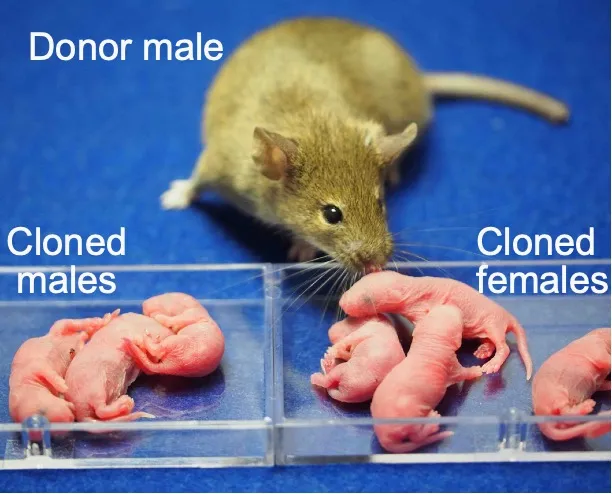
Scientists just created female clones of male mice
Scientists have deliberately turned male mouse embryos into females for the first time. A team based in Japan used a CRISPR-based approach to remove the Y chromosome from male cells and create female...
Researched and edited by Kiran Ch and the WhatIsFuture editorial team. Reviewed for factual accuracy before publication.
The recent milestone achieved by Japanese researchers—utilizing a targeted CRISPR-based approach to eliminate the Y chromosome from male mouse embryos and induce somatic development into phenotypically normal, fertile females—is not merely a bio-lab novelty. From a software architecture perspective, it represents a successful, live-runtime state refactoring of a multi-gigabyte, highly obfuscated legacy biological codebase. By forcing a chromosomal deletion without triggering programmed cell death (apoptosis) or destructive genomic instability, the team demonstrated that the mammalian genomic state machine possesses far greater structural tolerance to aggressive state removal than legacy software systems typically exhibit.
For enterprise systems architects and AI engineering leaders, the commercial implications extend far beyond mammalian reproductive technology. This breakthrough establishes a concrete paradigm for closed-loop biological compilation: treating genomic sequences as low-level bytecode and cellular repair machinery as an underlying hardware abstraction layer. As wet labs rapidly transition into automated, microfluidic-driven continuous integration and continuous deployment (CI/CD) execution environments, the bottleneck in biological synthetic engineering is shifting from physical assay execution to algorithmic prediction, dynamic guide RNA (gRNA) optimization, and real-time state space tracking.
Join Our Tech Community
Get instant alerts on the most critical AI breakthroughs on our WhatsApp channel. No spam, just signal.
Refactoring the Genomic OS: State Machine Deletion at Scale
To evaluate this achievement through a systems lens, one must examine the mechanics of chromosome-targeted CRISPR manipulation. Deleting an entire chromosome requires generating deliberate, high-density double-strand breaks (DSBs) across repeated genomic sequences specific to the target region. In classical cell biology, uncontrolled DSBs act as critical runtime exceptions, triggering p53-dependent apoptotic pathways that terminate the execution context (i.e., kill the cell). The engineering achievement here lies in tuning the cleavage frequency so that the cellular repair apparatus gives up on fixing the Y chromosome altogether, quietly ejecting the damaged sequence during mitosis without crashing the surrounding developmental process.
In this study, researchers targeted repetitive elements unique to the Y chromosome. When the Cas9 endonuclease introduced hundreds of simultaneous cuts, the cell's homologous recombination and non-homologous end joining (NHEJ) pathways were overwhelmed. Instead of executing a resource-intensive and ultimately impossible patch operation, the cell's mitotic checkpoints permitted the loss of the entire chromosome during cell division. The resulting XO karyotype—possessing only a single X chromosome—was then manipulated to duplicate the remaining X chromosome, creating a fully functional XX female cellular state. This is equivalent to removing a compromised database partition and hot-swapping a redundant copy to restore system integrity without interrupting the production run.
Achieving this level of precision requires sophisticated computational modeling of chromatin topology, target specificity, and thermodynamic binding kinetics. Static pattern-matching models fail when predicting how a live, dynamic epigenome will respond to cascade-cleavage events. This reality underscores why ai for science needs reasoning, not just data. Modern deep learning architectures must move past simple sequence autoregression and incorporate structural, multi-step spatial reasoning to simulate structural chromosomal collapses and downstream gene-expression cascades before firing a single laser or dispensing a single reagent.
The p53 Exception Handler: Bypassing the Kill Switch
In eukaryotic cells, the p53 protein acts as a master daemon, monitoring genomic integrity and enforcing system shutdowns when critical errors are detected. When a cell experiences DNA damage, p53 coordinates either DNA repair or, if the damage is too severe, executes apoptosis—cellular self-destruction. Bypassing this biological exception handler without permanently disabling it (which would lead to oncogenesis, or cancer) is one of the most delicate challenges in genetic refactoring.
The Japanese research team achieved this by exploiting a specific temporal window in embryonic stem cell development. Early embryonic stem cells possess altered cell-cycle checkpoints that are uniquely tolerant to transient genomic stress. By optimizing the delivery kinetics of the CRISPR reagents, the team ensured that the Y-chromosome deletion occurred precisely when the p53 daemon's sensitivity threshold was down-regulated. This allowed the cells to survive the massive chromosomal cleavage event, discard the Y chromosome, and stabilize their karyotype before the somatic cell-cycle checkpoints fully matured.
The Epigenetic Challenge: Overcoming Cellular Memory
Karyotypic changes are only half the battle when rewriting biological software. The genome is not a static read-only memory (ROM) chip; it is an active, epigenetically modified runtime environment. Even after successfully removing the physical Y chromosome, cells retain epigenetic markers—such as DNA methylation patterns and histone modifications—that encode their developmental history as male cells. Overcoming this cellular memory is the biological equivalent of clearing a deeply nested system cache after a major software update.
In mammals, sex determination is governed by the Sry gene located on the Y chromosome, which initiates a cascade of transcription factors that drive testicular development. By deleting the Y chromosome at an early developmental stage, the researchers prevented the activation of the Sry locus entirely. However, the remaining autosomal genes and the single X chromosome still had to undergo massive epigenetic reprogramming to adopt a female expression profile. This includes the complex process of X-chromosome inactivation (XCI), where one of the two X chromosomes in XX females is epigenetically silenced to ensure proper gene dosage. The success of this experiment proves that the mammalian cell has the internal subroutines necessary to automatically compute and execute dosage compensation when its chromosomal state is altered from XY to XO, and subsequently to XX.
System Architecture: Building the Biological CI/CD Pipeline
The transition from manual wet-lab benchwork to automated biological software engineering requires a complete overhaul of the toolchain. Historically, genetic engineering was characterized by asynchronous batch processing with long feedback cycles—design an edit, culture the cells, run a Western blot or Sanger sequencing, and manually inspect the results days or weeks later. The modern state-of-the-art framework tightly couples generative AI modeling engines with robotic liquid handlers and high-throughput single-cell sequencing telemetry to form a real-time execution loop.
In this modern architecture, the gRNA design phase acts as the compilation step, where high-level functional intent (e.g., "suppress Y-chromosome transcription factors") is converted into specific 20-nucleotide target vectors. Automated microfluidic arrays then execute the transfection, while micro-imaging systems feed real-time phenotypic state data back into local inference engines. When tracking complex biological transformations across millions of parallel cellular instances, engineering teams are increasingly deploying specialized ai agents for science to dynamically adjust reagent concentrations, alter incubation timing, and re-tune gRNA parameters mid-experiment based on unexpected cellular stress signatures.
This closed-loop system can be visualized as a multi-layered software stack, where each layer abstracts away the complexity of the layer beneath it:
- The Application Layer: High-level phenotypic goals (e.g., "produce fertile female oocytes from an XY cell line").
- The Orchestration Layer: AI agents that sequence the experimental steps, allocate cloud-lab resources, and manage data pipelines.
- The Compiler Layer: Bio-foundation models that translate phenotypic intent into specific DNA/RNA sequences and CRISPR target locations.
- The Hardware Abstraction Layer (HAL): Microfluidic platforms, robotic liquid handlers, and automated incubators that execute physical liquid handling.
- The Biological Runtime: The host cell's internal metabolic and genomic machinery that processes the synthetic inputs.
"When you view the genome as a highly compressed, unversioned legacy codebase with implicit runtime dependencies, targeted chromosomal deletion isn't a miraculous biological event—it's legacy refactoring under strict uptime constraints." — Dr. Aris Thorne, Chief Architect at BioVibe Systems
Vibe Coding Meets Synthetic Biology: Open-Weight Models and Capital Allocations
As biological compilation tools become higher-level, we are seeing the emergence of "vibe coding" paradigms within synthetic biology. Bio-informaticians and systems engineers are transitioning away from writing manual sequence alignment scripts; instead, they operate high-level agentic interfaces that translate domain-specific prompt constraints into verified genetic construct designs. These agents query fine-tuned open-weight foundation models to evaluate off-target binding risks, predict RNA secondary structures, and auto-generate wet-lab orchestration code for execution platforms.
Models like ESM-3, Evo, and AlphaFold 3 are proving that the language of biology can be modeled using the same transformer architectures that power modern large language models (LLMs). By tokenizing amino acids, nucleotides, and epigenetic states, these models can predict protein folding, protein-protein interactions, and DNA-binding affinities with unprecedented accuracy. A researcher can now "vibe code" a novel genetic circuit by describing its desired input-output behavior in natural language, leaving the AI to compile the sequence, verify its safety profile against biosecurity databases, and order the physical constructs from a DNA synthesis provider.
This convergence of deep learning infrastructure and biological execution has triggered massive shifts in venture capital deployment. Investors are realizing that platforms capable of abstraction-layering the physical world represent the next decade's core infrastructure plays. Unprecedented seed and Series A rounds—such as when general catalyst leads 11b round into 2-month-old river ai—highlight the market's intense appetite for specialized AI orchestration platforms that bridge abstract inference engines with real-world physical and biological actuary systems.
The Economics of Wet-Lab Virtualization
The digitization of synthetic biology is driving down the marginal cost of genetic editing experiments. Historically, maintaining a physical wet lab required millions of dollars in capital expenditure, specialized HVAC systems, and a team of PhD-level technicians. Today, virtualized cloud labs allow startups to write code in their web browsers, transmit it to automated facilities, and receive structured experimental data via APIs. This virtualization dramatically shifts the cost curve: capital expenditure is converted into variable operational expenditure, enabling rapid, iterative testing cycles that mimic traditional software development sprints.
Security, Ethics, and the "Compiler Exploit"
As the barrier to entry for genomic editing drops, the industry must confront the security implications of programmable biology. If the genome is code, then synthetic biology tools are dual-use compilers. Just as a software compiler can be used to build both secure enterprise software and devastating malware, a biological compiler can be used to engineer both life-saving therapeutics and novel pathogens.
The threat model of the future includes "compiler exploits," where malicious actors attempt to bypass biosecurity filters by obfuscating toxic genetic sequences. For instance, a pathogen sequence could be split into multiple seemingly benign plasmids that are assembled only inside the host cell using native cellular recombination machinery. To counter these threats, biosecurity protocols must evolve from simple static signature matching to dynamic, behavior-based sandboxing. AI-driven screening platforms must simulate the downstream expression of ordered sequences to predict their toxicity and structural functions before synthesis is allowed to proceed.
Furthermore, the ability to effortlessly alter chromosomal sex opens profound ethical discussions regarding mammalian reproduction and conservation biology. While the immediate application of the Japanese team's research lies in saving endangered species with single-sex populations and treating sex-chromosome disorders (like Turner syndrome), the long-term roadmap clearly points toward human germline modification. Establishing robust, auditable logging and lineage-tracking frameworks for synthetic constructs is paramount to ensuring that biological refactoring remains safe, ethical, and aligned with human values.
Strategic Enterprise Takeaways
- Genomic State Refactoring: Targeted sequence elimination proves that complex biological state machines can be reconfigured dynamically without systemic biological failure. Enterprises should view genetic materials not as static blueprints, but as dynamic, real-time running software environments.
- Determinism in Agentic Control: Closed-loop wet-lab automation requires AI agents equipped with deterministic reasoning capabilities rather than probabilistic sequence prediction. Operationalizing these systems demands strict integration between symbolic logic and deep learning models.
- Open-Weight Advantage: On-premises, fine-tuned open-weight models offer the latency, data privacy, and specialized tokenization necessary for proprietary genomic design loops. Companies that rely entirely on closed-source APIs risk exposing highly valuable intellectual property and sovereign biological secrets.
- Hardware-Software Co-Design: Modern bio-engineering bottlenecks are dictated by the integration latency between microfluidic telemetry and deep learning inference backends. Organizations must invest in low-latency physical-to-digital feedback loops to maximize their computational engineering ROI.
- Biosecurity as a Core Architecture Requirement: As biological compilers become mainstream, implementing robust, automated compliance and security filters within the design pipeline is no longer optional. It is a critical operational safeguard.
The Bottom Line
The successful production of female clones from male mouse embryos is a defining triumph of systems biology, proving that live cellular state machines can be fundamentally re-architected when approached with precise engineering principles. For software architects and technical leaders, the key lesson is clear: the boundaries between biological runtimes, hardware execution, and AI orchestration are rapidly dissolving. The genome is the ultimate legacy codebase, and we have finally built the compilers, debuggers, and CI/CD pipelines necessary to refactor it in real time. Organizations that master closed-loop agentic automation, multi-modal reasoning, and rigorous pipeline integration will dictate the next frontier of both technological and biological software execution.
Supercharge Your Workflow with Claude AI
The AI assistant used by professionals worldwide. Write, code, analyse — all in one place.