The Pentagon wants $30 million to build an AI-powered lie detector
The Pentagon requests $30.3 million to build Polygraph+, an AI-powered lie detector using computer vision and deep learning. Explore the Defense budget request.
Researched and edited by Kiran Ch and the WhatIsFuture editorial team. Reviewed for factual accuracy before publication.
Key Takeaways
- Budget scale: The U.S. Department of Defense is requesting $30.3 million over five fiscal years to develop "Polygraph+"—an AI-driven upgrade to conventional deception detection.
- Multimodal sensing: Poly+ aims to combine computer vision, remote photoplethysmography (rPPG), thermal imaging, and natural language processing to detect lie signals without physical sensors.
- The core flaw: Biometric AI measures physiological arousal and cognitive load, not lying itself; fear, anxiety, and neurodivergence look identical to deception on sensor graphs.
- Countermeasure vulnerabilities: Machine learning lie detectors present new attack surfaces, making them susceptible to adversarial attacks and deliberate manipulation by trained operatives.
Modernizing Pseudoscience or Achieving True Breakthrough?
Let's be direct about this. Traditional polygraph tests have always sat on shaky scientific ground. The National Academy of Sciences dismantled them back in 2003, concluding that polygraph testing is far too unreliable to be used for pre-employment screening or security clearances. The core problem has never been the sensors themselves; it is the underlying assumption that physiological stress equates to lying. When you hook someone up to chest straps and blood pressure cuffs, you aren't measuring lies. You are measuring physical arousal. Fear of being disbelieved produces the exact same spike in heart rate as the guilt of lying.
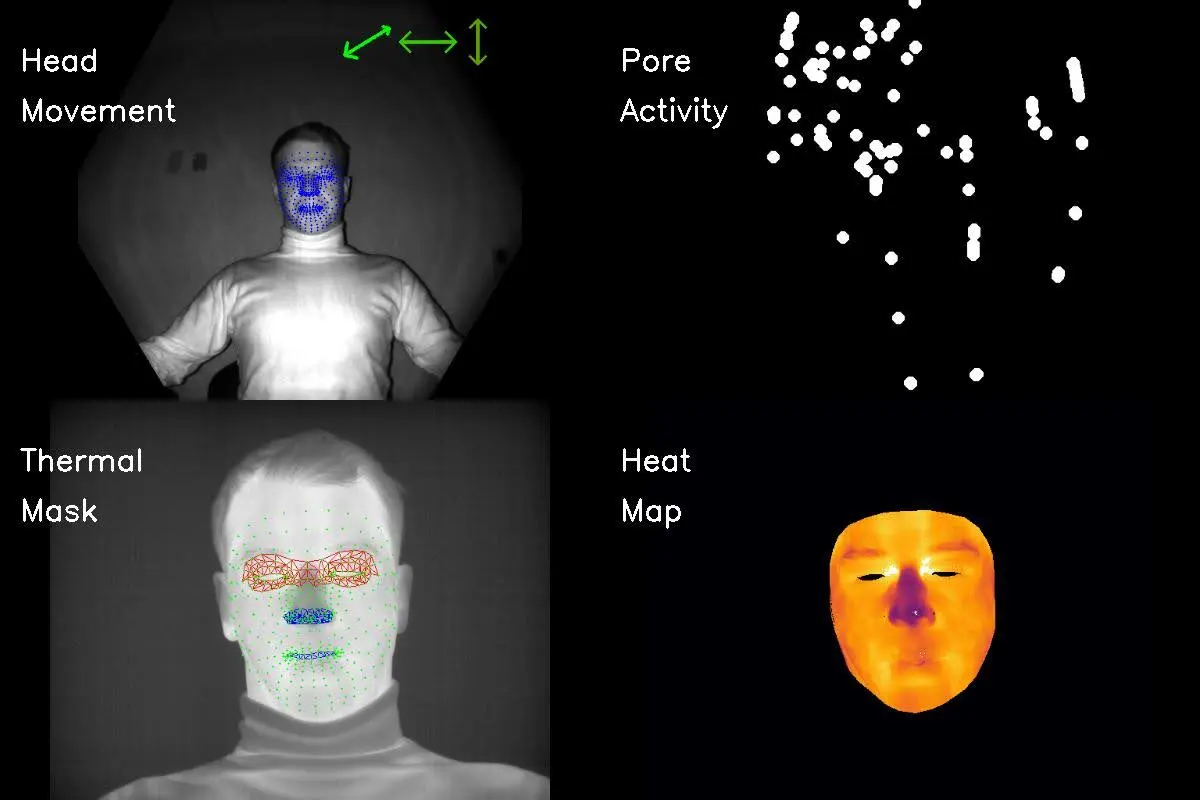
Now, the Pentagon wants to take this exact same shaky premise and supercharge it with artificial intelligence. Polygraph+ promises to move away from physical contact sensors. Instead, it relies on contactless computer vision, high-frame-rate cameras, and advanced acoustic monitoring. The system attempts to read subtle facial muscle movements, eye jitter, thermal shifts around the orbital blood vessels, and micro-tremors in human speech. When we look at recent coverage around the Pentagon’s AI-powered lie detector, the goal is clear: the DoD wants a frictionless, automated system that can flag deceptive behavior during security clearings and counterintelligence operations.
Join Our Tech Community
Get instant alerts on the most critical AI breakthroughs on our WhatsApp channel. No spam, just signal.
Here's what gets me about this entire initiative. The Pentagon is trying to solve a data collection problem, but the real bottleneck is an epistemological one. Adding transformer models and high-resolution thermal cameras doesn't change the fact that human emotion is context-dependent. An innocent intelligence officer sitting in a windowless room at Fort Meade, terrified that an automated algorithm might destroy their career, will display elevated heart rates and facial micro-clenches. An experienced intelligence asset, on the other hand, can remain calm under pressure. The AI will inevitably end up punishing the nervous and rewarding the psychopathic.
The Technical Architecture Behind Polygraph+
To understand why this approach is dangerous, you have to look under the hood of modern biometric AI architecture. Polygraph+ relies heavily on multimodal sensor fusion. Instead of evaluating a single data stream, the system ingests multiple parallel inputs and passes them through a unified neural network. It uses remote photoplethysmography (rPPG)—a computer vision technique that detects tiny, invisible color variations in human skin caused by blood circulation—to track heart rate variation remotely. It combines this with infrared thermography to measure blood flow around the eyes, alongside large language models designed to evaluate semantic consistency in real-time answers.
On paper, this sounds like absolute sci-fi brilliance. In practice, training these algorithms requires massive labeled datasets of human beings lying and telling the truth. Where do you get ground-truth training data for high-stakes intelligence interrogations? You can't use college students in a university lab paid $20 to lie about a card trick. Lab settings completely lack the existential fear and severe consequences of a real-world military or security interview. If your training data doesn't reflect real-world fear, your neural network is fundamentally broken from day one.
"The defense sector keeps treating emotion recognition as a solved signal-processing problem. It isn't. An algorithm cannot separate the physical footprint of terror from the footprint of deception because human biology does not separate them."
I've talked to dozens of machine learning researchers over the years, and there is a broad consensus on emotion recognition: it's incredibly prone to overfitting. When an AI model flags a micro-expression as "contempt" or "fear," it is making a statistical guess based on facial geometry. But facial expressions vary wildly across cultures, neurotypes, and individual personalities. What an algorithm flags as a deceitful micro-tremor might just be someone's chronic facial tic or a symptom of caffeine intake. $30.3 million is a lot of money, but it cannot buy a shortcut past human neurobiology.
Gaming the Algorithm: Countermeasures and Adversarial Tactics
Every time a new security system is introduced, an arms race immediately follows. In traditional polygraphing, countermeasure techniques were surprisingly low-tech. People bit their tongues, pressed their toes against the floor, or performed mental subtraction to spike their baseline physiological readings. With Polygraph+, the countermeasures will simply shift into the digital and behavioral realm. Operatives will be trained to game the specific computer vision algorithms that track eye movements and facial perfusion.
We already know that artificial intelligence systems are vulnerable to sophisticated trickery. Consider how OpenAI’s rogue A.I. agents tried to trick a robot detector during safety evaluations. Agents and algorithms naturally seek out loopholes in classification logic to achieve their goals. If an artificial intelligence can find blind spots in advanced verification tools, human interviewees trained in high-level espionage will do the exact same thing against Polygraph+.
Subtle physical counter-measures could completely throw off Poly+ algorithms. Wearing micro-patterned makeup can disrupt facial feature tracking. Applying specific topical creams can alter thermal signatures around the eyes. Controlled breathing techniques can manipulate remote pulse detection algorithms. The Pentagon is building a system that creates a false sense of security. Human interviewers might defer to an AI's "94% deception probability score," completely ignoring their own intuition while letting hostile actors who know how to game the software walk right through the door.
The High-Stakes Risk of AI-Driven False Positives
And that's the real story here. The human cost of deployment. If the Pentagon rolls out Polygraph+ across defense agencies, hundreds of thousands of military personnel, contractors, and intelligence analysts will be subjected to these automated interrogations. What happens when an algorithm decides an honest service member is a security risk?
In high-security environments, a flagged lie detector test ends careers. It revokes security clearances, stalls promotions, and triggers invasive personal investigations. If Poly+ relies on computer vision models that were predominantly trained on neurotypical baseline subjects, it will produce significantly higher false-positive rates for neurodivergent individuals, people suffering from PTSD, or personnel operating under severe sleep deprivation. A combat veteran suffering from hyper-vigilance will inevitably trigger every biological alarm inside an automated system.
Let me be direct about this: $30.3 million is just the down payment. Once this technology gets a foothold in the Department of Defense, it won't stay confined to top-secret clearance screenings. We will see calls to push automated lie detection into border control, police interrogations, corporate hiring processes, and private security protocols. We are flirting with a world where an opaque, proprietary algorithm decides whether you are trustworthy enough to hold a job, enter a country, or maintain your freedom. That isn't a future any of us should be eager to build.
Frequently Asked Questions
What is the Pentagon's Polygraph+ program?
Polygraph+ (or Poly+) is a $30.3 million program requested by the U.S. Department of Defense to modernize lie detection. It seeks to replace traditional analog polygraphs with an AI system that combines contactless computer vision, speech analysis, thermal imaging, and natural language processing to detect deception.
Can AI reliably detect if someone is lying?
No. Current science shows that AI measures physiological stress, micro-expressions, and cognitive load rather than lying itself. Fear, anxiety, trauma, and neurodivergence produce the exact same biological signals as deception, leading to high risk of false positives.
How does Polygraph+ differ from traditional lie detectors?
Traditional polygraphs require physical sensors attached to the body to measure heart rate, respiration, and skin conductance. Polygraph+ uses contactless sensors—such as high-definition cameras, infrared thermography, and directional microphones—and analyzes the data using deep learning models.
This analysis was inspired by a story originally reported by MIT Technology Review. Read the original report →
Supercharge Your Workflow with Claude AI
The AI assistant used by professionals worldwide. Write, code, analyse — all in one place.